Best Crypto Tax Tools in 2026, by Job: Filing, Firm Workflows, and Classification
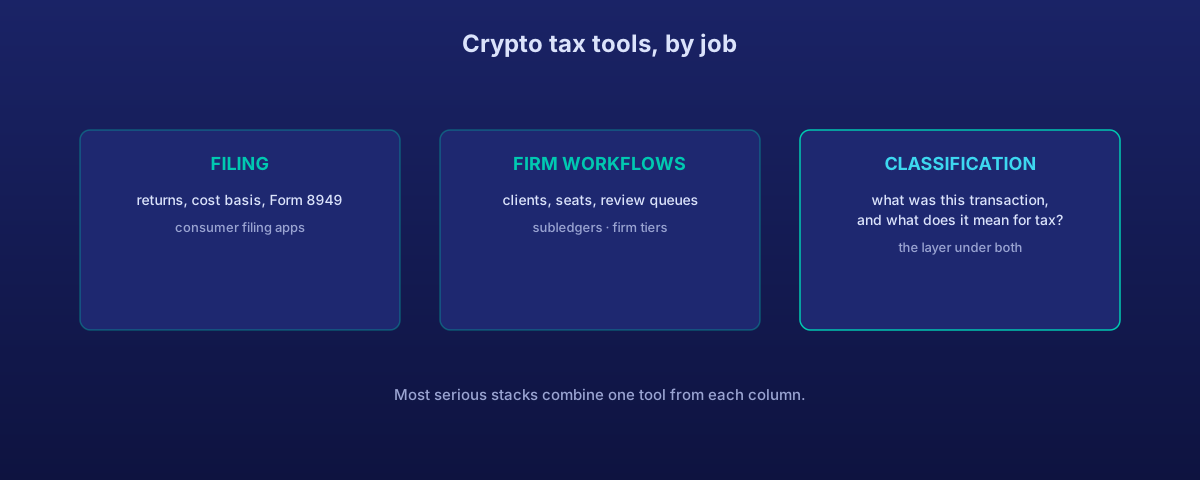
There is no single "best crypto tax tool" - there are three different jobs, and the best stack for 2026 usually combines one tool from each. Filing apps assemble a return. Firm platforms run client workflows at scale. And underneath both sits the newest layer: classification - working out what each on-chain transaction actually was, and what it means for the return.
This guide is organized by job, because that is how the decision actually works.
What are the jobs a crypto tax tool can do?
Filing. Import wallets and exchanges, compute cost basis and gains, produce Form 8949 and a report your preparer can use. This is what most people mean by "crypto tax software."
Firm workflows. Multi-client dashboards, team seats, review queues, exports into the general ledger. Built for accountants and bookkeeping teams, not individual filers.
Classification. Given a raw transaction - a hash on a chain - determine the canonical event (swap, liquidity add, reward, repayment, bridge), the US tax treatment it implies, and how confident that call is. Filing apps do a version of this internally; the classification layer exists because DeFi routinely defeats it.
Which filing apps should individuals look at?
For straightforward portfolios - exchanges plus some on-chain activity - the established filing apps do the job: Koinly, CoinLedger, CoinTracker, and TokenTax all import from major exchanges and chains, compute basis, and produce Form 8949. They differ in pricing tiers (typically by transaction count), exchange coverage, and how much DeFi they handle cleanly.
The honest caveat that applies to all of them: heavy DeFi activity produces uncategorized and mislabeled rows. Users see "unknown transaction," and the fix is manual research - which is exactly the gap the classification layer exists to close.
What do accounting firms and bookkeeping teams use?
Firms need what consumer apps don't offer: pooled team access, per-client books, review workflows, and a defensible record of who decided what. Crypto-native subledger and close platforms serve the bookkeeping side, and firm tiers of the filing apps serve smaller practices.
CryptoTaxEdge's Firm plan sits in this category for the classification part of the job: $199/month covers 2 seats and 20,000 billable classifications pooled across the team, with the Chrome extension bringing classifications directly into the tax platforms a firm already uses. Plain transfers, approvals, spam, failed rows, and repeats never count against the pool, so teams route entire client books through it without pre-filtering.
What is the classification layer, and when do you need it?
You need it the moment "what was this transaction?" becomes the bottleneck - for a filer with a DeFi-heavy wallet, a firm with crypto-native clients, or a platform building tax features.
A classification engine takes a transaction hash and returns the event type, the tax treatment (disposal under IRC §1001, ordinary income under §61 and Rev. Rul. 2023-14 for staking rewards, or non-taxable), a confidence score, and - critically - an honest flag when the call needs professional review instead of a guess. CryptoTaxEdge is built as this layer: it works alongside filing apps rather than replacing them, covers 80+ chains with 15,000+ verified classification rules, and is the only tool in this guide with a free way to test the claim - enter any transaction hash into the Classification Explorer, 10 lookups a day, no signup.
For developers, the same engine is an API and an MCP server: submit hashes, get classifications with confidence and review flags on the wire. That job - tax treatment, programmatically - has few direct answers today; the tools marketed as "crypto tax APIs" sell transaction data feeds, not treatments.
How do the three jobs fit together in one stack?
A typical 2026 stack, by user:
Individual with DeFi activity: a filing app for the return + the Classification Explorer for every row the app couldn't categorize.
Accounting firm: the client's filing app or subledger for books and returns + CryptoTaxEdge Firm for classification, review flags, and the extension overlay inside the platform they already use.
Platform or fintech: their own product + the classification API underneath it, so every transaction ships with a treatment and a confidence score instead of a raw label.
FAQ
What is the best crypto tax tool overall in 2026? For filing a personal return: one of the established filing apps, chosen by your exchange mix and transaction count. For classifying what DeFi transactions actually were: a dedicated classification layer. Most serious users end up with one of each.
Do crypto tax tools handle DeFi correctly? Filing apps handle common DeFi patterns and routinely miss the long tail - LP positions, bridges, restaking, protocol-specific flows. That gap is measurable: classification-layer review of typical DeFi books finds a large share of rows the filing app left unknown or mislabeled. How this is measured is published at cryptotaxedge.com/methodology.
Is there a free way to check a single transaction? Yes - the Classification Explorer classifies any transaction hash free, 10 a day without an account, showing the event type, tax treatment, confidence, and reasoning.
What about tax professionals - do these tools replace judgment? No. A well-built classification result states its confidence and flags genuinely uncertain rows for professional review rather than guessing. Classifications are informational, not tax advice; a qualified professional signs the return.