Why Your Crypto Tax Review Process Needs a Second Layer
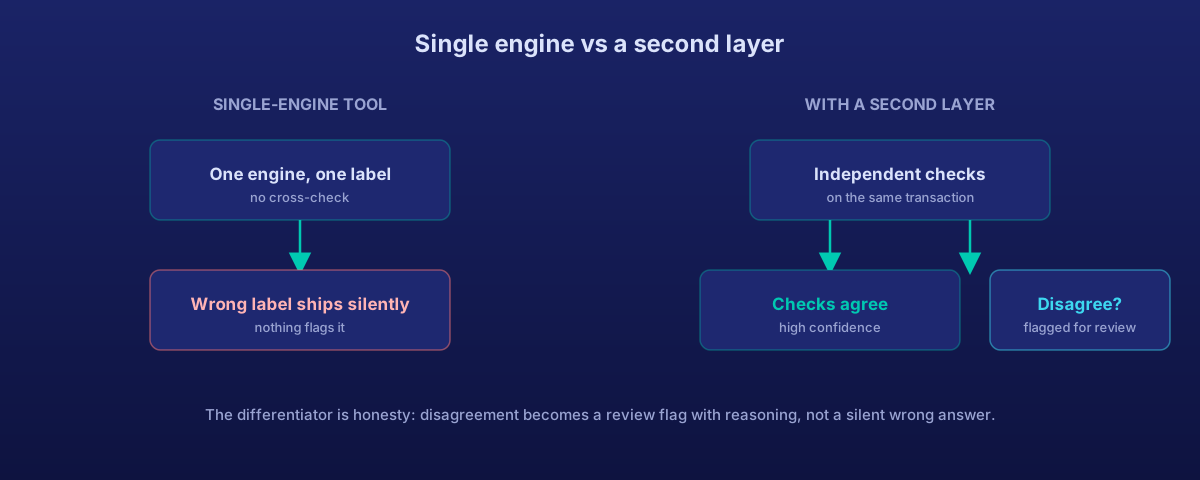
TL;DR: Most filing-focused tools, from the major platforms to manual spreadsheet review, classify from a single engine's read. For exchange trades and simple swaps, that works. But when your clients are deep in DeFi (LP positions, cross-chain bridges, rebasing tokens, multi-hop swaps), single-source classification can silently misclassify transactions without flagging them for review. For CPAs filing on behalf of clients, a multi-source verification layer is designed to catch what a single engine can miss. CryptoTaxEdge's Chrome extension works directly inside the major crypto tax platforms to add that second layer.
   SINGLE-ENGINE TOOL                    WITH A SECOND LAYER

   transaction ──▶ one engine            transaction ──▶ independent checks
                    │                                       │
                    ▼                                       ▼
              one label,                          checks agree ──▶ high confidence
              no cross-check,                     checks disagree ─▶ FLAGGED for
              no flag when wrong                  professional review, with reasoning
Where Today's Tools Excel
Before discussing gaps, it is worth acknowledging what existing crypto tax tools do well. Platforms like Koinly, CoinLedger, CoinTracker, and ZenLedger have built solid products that serve a real need.
Exchange imports are reliable. Koinly alone supports API connections and CSV imports from hundreds of centralized exchanges. CoinLedger, CoinTracker, and ZenLedger offer similar breadth. For clients whose activity is primarily on Coinbase, Kraken, or Binance, the import process is straightforward and the resulting classifications are generally sound.
Portfolio tracking is useful. Most platforms give clients a clear view of holdings, gains, and losses across wallets. For individuals managing their own taxes, this is a meaningful time saver.
Simple swaps and transfers are handled well. Token-to-token swaps on major DEXs, internal transfers between wallets, and straightforward staking rewards are areas where single-source classification engines perform reliably across all the major tools.
Tax reports are well-organized. These platforms produce jurisdiction-specific reports (Form 8949, Schedule D) that integrate directly with TurboTax, H&R Block, and manual filing workflows.
For clients with exchange-heavy portfolios and minimal DeFi exposure, any of these tools on its own may be entirely sufficient. The question is what happens when the on-chain activity gets more complex.
Where Single-Source Classification Silently Fails
The challenge with any single classification engine (Koinly, CoinTracker, TokenTax, or manual spreadsheets) is that complex DeFi transactions often look ambiguous when viewed from only one data source. The word "silently" matters here: the tool does not throw an error. It assigns a classification, and that classification may be wrong.
Here are the transaction types that most commonly produce silent misclassifications:
Liquidity Pool Positions
When a client deposits two tokens into an AMM liquidity pool and receives an LP token in return, the tax treatment is genuinely contested under IRC §1001: the house default treats entry and exit as taxable disposals, while a defensible alternative treats the position as non-taxable continuity until final exit. Either way it must be a documented choice, not a silent assumption. And when the client later withdraws (possibly receiving different ratios of the underlying tokens due to impermanent loss), the treatment again depends on the position chosen at entry, applied consistently at exit.
Single-source tools frequently classify the deposit as a swap (two tokens out, one LP token in), which creates phantom taxable events. The withdrawal gets similar treatment in reverse. For a client with dozens of LP positions across multiple protocols, these misclassifications compound.
Cross-Chain Bridges
Bridging ETH from Ethereum to Arbitrum is economically a transfer: the client still owns the same asset, just on a different network. But on-chain, it looks like a deposit to a bridge contract on one chain and a mint on another. Without correlating data across both chains, a classification engine may tag the bridge deposit as a send to an unknown address (potentially a disposal) and the receiving side as income.
Rebasing Tokens
Tokens like stETH or OHM that adjust balances automatically create a particular challenge. Each rebase changes the wallet balance without a corresponding transaction. Some tools pick these up as income events; others miss them entirely. Neither approach is necessarily correct for all jurisdictions, but the important thing is that the CPA reviewing the return needs to know they exist and how they have been handled.
Multi-Hop Swaps and Aggregator Transactions
When a client uses a DEX aggregator like 1inch or Paraswap, a single user-initiated swap may route through three or four liquidity pools in a single transaction. The on-chain trace shows multiple intermediate token transfers. A classification engine working from raw transaction data may interpret these intermediate hops as separate taxable events rather than recognizing the single economic swap the user intended.
Cross-Chain Messaging and Complex Protocol Interactions
Transactions involving protocols like LayerZero, Wormhole, or Chainlink CCIP span multiple networks and often involve token locks, mints, burns, and message relays. Classifying these correctly requires understanding the protocol's architecture, not just the token movements visible on a single chain.
What Accountants Currently Do to Verify
Every CPA who has filed crypto returns for DeFi-active clients knows the workflow. It usually looks something like this:
- Import into your tax tool (Koinly, CoinLedger, CoinTracker, etc.) and generate a draft report.
- Export the transaction list to a spreadsheet.
- Open the chain's block explorer in another tab.
- Manually spot-check transactions that look suspicious: large amounts, unknown tokens, multiple transfers in a single transaction.
- Cross-reference the explorer data with the classification the tool assigned.
- Google the protocol to understand what actually happened.
- Manually reclassify transactions in the spreadsheet or back in the tax tool.
- Repeat for every chain the client used.
This process works. It is also slow, error-prone, and does not scale. A single DeFi-active client can have hundreds of transactions that warrant manual review. During tax season, when a firm may be handling dozens of crypto clients simultaneously, the spreadsheet-check workflow becomes a bottleneck.
The core problem is not that CPAs lack the knowledge to classify correctly. It is that the verification step, comparing the tax tool's output against what actually happened on-chain, requires too many manual lookups across too many sources.
The Multi-Source Verification Approach
The alternative to single-source classification is not replacing the tool. It is adding a verification layer that cross-references multiple data sources before a classification is finalized.
A multi-source approach cross-checks the same transaction from independent angles: on-chain activity, protocol context, and known DeFi patterns, including across chains where bridges are involved. Agreement raises confidence; disagreement is flagged for the CPA with the reasoning attached.
When multiple sources agree on a classification, confidence is high. When they disagree, the transaction gets flagged for human review. This is the key difference: instead of silently assigning a best guess, a multi-source system surfaces the ambiguity so the CPA can make the final call.
This verification layer does not replace your existing tax tool. It sits on top of the existing workflow, whether you use Koinly, CoinLedger, CoinTracker, ZenLedger, or manual spreadsheets, and adds the cross-referencing step that CPAs currently do manually.
For a deeper look at how AI-driven classification handles DeFi complexity, classify a transaction in the Classification Explorer and read the result. How this is measured is published on the methodology page.
How the CryptoTaxEdge Chrome Extension Works With Koinly
CryptoTaxEdge is designed to function as a review layer, not a replacement for existing tools. The Chrome extension operates directly inside Koinly's interface, which means CPAs do not need to switch between applications or export data to a separate platform.
Here is how the workflow looks in practice:
- Open Koinly in Chrome with the CryptoTaxEdge extension installed.
- Navigate to a client's transaction list as usual.
- The extension identifies transactions and runs them through multi-source classification.
- Transactions where the CryptoTaxEdge classification matches Koinly are left alone: they have been independently verified.
- Transactions where classifications diverge are highlighted with the CryptoTaxEdge assessment and a short, CPA-readable explanation of why it differs, so you decide.
- The CPA reviews the flagged items and makes the final classification decision.
This workflow preserves everything that works about Koinly while eliminating the manual spreadsheet-check step. The CPA still has final authority over every classification. The extension just surfaces the transactions that need attention.
Learn more about how the classification engine works on the CryptoTaxEdge homepage.
Side-by-Side Comparison
| Feature | Typical filing app (single engine) | CryptoTaxEdge (Review Layer) |
|---|---|---|
| Exchange API imports | Yes: hundreds of exchanges supported | No (uses the filing app's imports) |
| Portfolio tracking dashboard | Yes | No (not a portfolio tool) |
| Tax report generation (Form 8949, etc.) | Yes | No (uses the filing app's reports) |
| Simple swap classification | Strong | Verifies the filing app's output |
| DeFi LP position handling | Often needs review | Grey area surfaced with both positions |
| Cross-chain bridge detection | Limited: chains analyzed independently | Correlates data across chains |
| Rebasing token tracking | Partial | Flags rebasing events with on-chain data |
| Multi-hop swap recognition | Partial: may split into multiple events | Identifies aggregator routing patterns |
| CPA-specific review workflow | General-purpose UI | Built for accountant review workflow |
| Data sources per transaction | Primarily exchange/wallet imports | Multiple on-chain sources + protocol context |
| Chrome extension overlay | N/A | Yes: works inside the filing app |
| Bulk transaction analysis | Per-wallet import | Batch hash analysis via Classification Explorer |
| Confidence flagging | No: all classifications presented equally | Yes: flags low-confidence items for review |
| Intended user | Individual taxpayers and accountants | CPAs and tax professionals |
This comparison is intentionally straightforward. A filing app is a full-service tax platform; CryptoTaxEdge is a classification verification layer. They serve different functions in the same workflow.
When to Use Koinly Alone vs. When to Add a Second Layer
Koinly alone is likely sufficient when:
- The client primarily trades on centralized exchanges (Coinbase, Kraken, Binance, Gemini)
- DeFi activity is limited to simple token swaps on a single chain
- The client does not interact with LP positions, bridges, or complex protocols
- The total transaction volume is manageable for manual spot-checking
- The filing is for an individual taxpayer doing their own return
Adding a verification layer makes sense when:
- The client has meaningful DeFi exposure across multiple protocols
- LP positions, yield farming, or liquidity mining are involved
- The client uses cross-chain bridges or multi-chain strategies
- Transaction volume is high enough that manual verification does not scale
- You are a CPA or firm filing on behalf of clients and need defensible classifications
- The client interacts with newer or less common protocols where classification engines have limited training data
- Rebasing tokens, airdrops from governance participation, or protocol-specific rewards are present
The decision is not either/or. The strongest workflow for DeFi-active clients uses both: Koinly for the data import, portfolio view, and tax report generation, plus a verification layer for classification confidence.
For firms handling multiple crypto clients, the CryptoTaxEdge approach to multi-source verification reduces the time spent on manual cross-referencing while increasing classification confidence.
Getting Started
The CryptoTaxEdge Chrome extension installs in under a minute and works inside Koinly without any configuration changes to your existing setup. There is no data export required and no need to migrate clients to a new platform.
If you are a CPA or tax professional handling DeFi-active clients, adding a multi-source verification layer to your review process reduces risk and saves time during filing season.
Install the Chrome extension and run it alongside Koinly on your next client review. See which transactions get flagged and decide for yourself whether the second layer adds value to your workflow.
For bulk analysis of transaction hashes outside of Koinly, the CryptoTaxEdge Classification Explorer processes batches of transactions against multiple on-chain data sources.
CryptoTaxEdge is built for CPAs and tax professionals who need defensible crypto transaction classifications. It is not a replacement for your existing tax software; it is the verification layer that makes your existing tools more reliable. Learn more.