How to Classify DeFi Transactions for Form 8949: A CPA's Guide
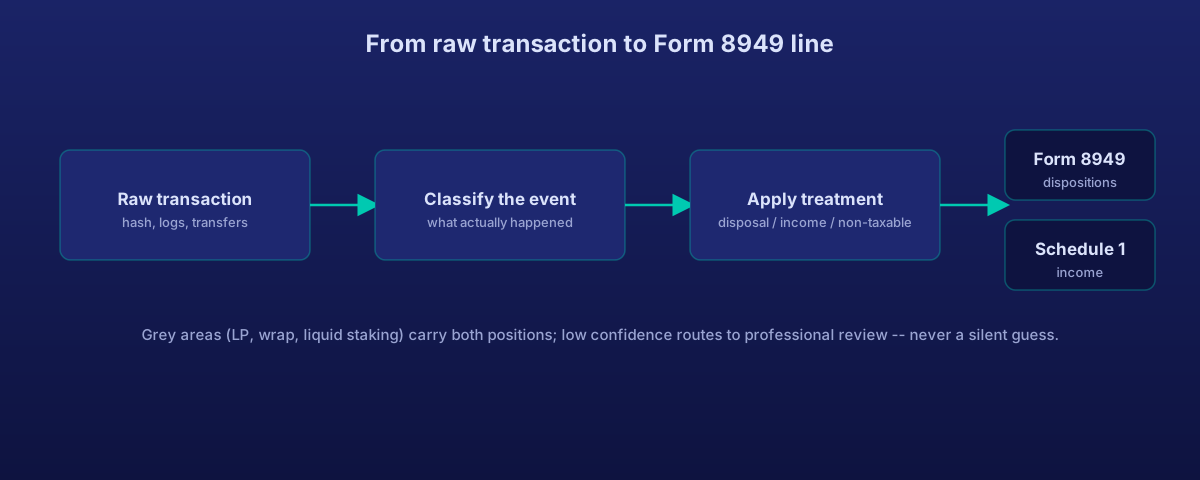
TL;DR: Classifying DeFi transactions for Form 8949 requires identifying the taxable event type for each on-chain interaction, mapping it to the correct IRS disposition category, and documenting your methodology in case of examination. Unlike centralized exchange activity, DeFi transactions lack standardized 1099 reporting, involve multi-step smart contract interactions, and frequently produce ambiguous events that demand professional judgment. This guide provides a systematic framework for getting it right.
DeFi Transaction Classification Flowchart
==========================================

              Transaction Hash
                     │
                     ▼
     ┌───────────────────────────────┐
     │    What happened on-chain?    │
     ├───────────────────────────────┤
     │                               │
     │  Swap tokens?            ──▶  Trade (Capital Gains)
     │  Added liquidity?        ──▶  Add to Pool (Grey area: see taxonomy)
     │  Removed liquidity?      ──▶  Remove from Pool (Grey area: see taxonomy)
     │  Staking rewards?        ──▶  Income (Ordinary Income)
     │  Bridge transfer?        ──▶  Transfer (Non-taxable)
     │  Liquidation?            ──▶  Disposal (Capital Loss)
     │  Airdrop received?       ──▶  Income (FMV at receipt)
     │  LP fee collection?      ──▶  Income (Ordinary Income)
     │                               │
     └───────────────┬───────────────┘
                     │
                     ▼
          Form 8949 / Schedule 1

  * LP deposit/withdrawal taxability depends on
    jurisdiction and CPA interpretation - see
    per-protocol examples below.
LP grey area, stated once for this whole guide: adding or removing pool liquidity is contested under IRC §1001. House default: a taxable disposal and reacquisition at entry and exit. Alternative position: pool-position continuity (non-taxable entry/exit, economics recognized at final exit). Fees are ordinary income at collection (Notice 2014-21 by analogy; timing is a judgment call). CryptoTaxEdge flags this as grey_area and shows both positions rather than silently asserting one.
Why DeFi Classification Is Harder Than CEX Transactions
Centralized exchanges produce trade history exports with clear buy/sell pairs, timestamps, and USD cost basis. DeFi operates differently. A single wallet interaction with a protocol like Uniswap or Aave can generate multiple token transfers across several smart contract calls, none of which arrive with a pre-computed cost basis or a clean label.
The core difficulties for practitioners include:
- No 1099 reporting. DeFi protocols issue no information returns at all: not 1099-B, not 1099-MISC, and, after the April 2025 repeal of the DeFi broker rule, not the new Form 1099-DA either (does 1099-DA cover DeFi?). The practitioner must reconstruct the full transaction history from on-chain data.
- Multi-step atomic transactions. A single blockchain transaction can contain a swap, a fee collection, and a token approval simultaneously. Each sub-event may have distinct tax treatment.
- Protocol-specific mechanics. Depositing into a Curve pool behaves differently from depositing into an Aave lending market, even though both involve sending tokens to a smart contract.
- Ambiguous IRS guidance. Existing guidance covers the basics of cryptocurrency as property (IRS Notice 2014-21) and staking rewards (Rev. Rul. 2023-14), but does not address most DeFi-specific events directly.
The result is that classification errors are common, and the consequences range from overpayment to underreporting exposure during examination.
The 1099-DA Era: What Changed for 2025 and 2026
Two reporting regimes now sit side by side, and Form 8949 is where they meet.
Custodial activity gets a form. Under the final broker regulations (T.D. 10000), custodial brokers report gross proceeds on Form 1099-DA for digital-asset sales effected on or after January 1, 2025. Basis reporting phases in only for covered assets: units acquired in that broker's custody on or after January 1, 2026, and held there continuously. Everything a client transferred in from a wallet stays noncovered, so 2025-season forms arrived overwhelmingly proceeds-only, and transferred-in lots will keep arriving that way. The reconstruction workflow for those rows is covered in Why does my 1099-DA show no cost basis?
DeFi gets no form, permanently for now. The companion DeFi broker regulations (T.D. 10021) were disapproved under the Congressional Review Act in April 2025, so DEXs, protocol front-ends, and self-custody wallet software issue nothing, and a substantially similar rule cannot return without new legislation. Notice 2024-57 additionally keeps six transaction types out of broker reporting even at custodial platforms pending further guidance: wrapping and unwrapping, liquidity-provider transactions, staking, lending, short sales, and notional principal contracts. All of it remains taxable; none of it arrives on paper.
Form 8949 grew digital-asset checkboxes. The 2025 revision added boxes G, H, and I for short-term digital-asset transactions and J, K, and L for long-term: G and J for 1099-DA rows with basis reported to the IRS, H and K for 1099-DA rows without reported basis, and I and L for dispositions with no 1099-DA at all. DeFi activity classified with this guide lands in I and L; proceeds-only exchange rows land in H and K with basis from the client's reconstructed records. Since January 1, 2025, that basis must also be tracked wallet by wallet rather than pooled (Rev. Proc. 2024-28 governed the transition).
Taxable Events Taxonomy for DeFi
Before examining protocol-specific behavior, practitioners need a working taxonomy of DeFi taxable events. The following table maps common DeFi actions to their likely Form 8949 treatment under current guidance.
| DeFi Action | Taxable Event? | Form 8949 Category | Primary Authority |
|---|---|---|---|
| Token swap (e.g., ETH to USDC) | Yes | Disposition of property | IRC Section 1001; Notice 2014-21, Q&A 6 |
| Liquidity pool deposit | Contested: see grey-area note above | Disposition of deposited tokens for LP tokens | IRC Section 1001 (exchange of property) |
| Liquidity pool withdrawal | Contested: see grey-area note above | Disposition of LP tokens for underlying assets | IRC Section 1001 |
| Staking rewards received | Yes, at receipt | Ordinary income at FMV | Rev. Rul. 2023-14 |
| Bridge transfer (same token, different chain) | Generally no | No disposition if same beneficial ownership | Analogous to wallet-to-wallet transfer |
| Liquidation (collateral seized) | Yes | Involuntary disposition | IRC Section 1001 |
| Airdrop received | Yes, at receipt | Ordinary income at FMV | Rev. Rul. 2023-14 (by analogy); Notice 2014-21 |
| Wrapping/unwrapping (e.g., ETH to WETH) | Uncertain | Arguably not a disposition if 1:1 and redeemable | No direct guidance |
A note on authority: IRS Notice 2014-21 established that virtual currency is treated as property for federal tax purposes, meaning general property disposition rules under IRC Section 1001 apply. Rev. Rul. 2023-14 confirmed that staking rewards are includible in gross income in the taxable year the taxpayer gains dominion and control. Beyond these, practitioners are largely working by analogy and professional judgment.
Per-Protocol Classification Examples
Uniswap V3: Swaps and Concentrated Liquidity
Deep reference for this section: the full Uniswap V3 LP lifecycle guide. Quick answers: is a crypto-to-crypto swap taxable? · are staking rewards taxable? · the full treatment taxonomy.
Swap. A straightforward Uniswap swap (e.g., 1 ETH for 2,000 USDC) is a taxable disposition of ETH under IRC Section 1001. The amount realized is the FMV of USDC received. The cost basis is the taxpayer's adjusted basis in the ETH disposed of.
Concentrated liquidity provision. When a user deposits Token A and Token B into a Uniswap V3 position, they receive an ERC-721 NFT representing that position. The defensible position is that this constitutes a disposition of both Token A and Token B in exchange for the LP NFT. Upon withdrawal, the reverse occurs: the NFT is disposed of, and the tokens received constitute amount realized. The complicating factor is that the ratio of Token A to Token B at withdrawal will differ from the deposit ratio due to price movement, creating gain or loss calculations that require careful tracking of the NFT's basis.
Aave V3: Supply and Borrow
Supplying assets. When a user deposits USDC into Aave V3, they receive aUSDC (an interest-bearing receipt token). The question is whether this constitutes a taxable exchange. A reasonable position treats it as analogous to a bank deposit rather than a property disposition, since aUSDC is redeemable 1:1 for USDC plus accrued interest. However, the counter-argument exists that any exchange of one digital asset for a different digital asset triggers IRC Section 1001. Practitioners should document whichever position they adopt.
Interest accrual. The aUSDC balance increases continuously as interest accrues. Under Rev. Rul. 2023-14's reasoning regarding staking rewards, these interest accruals are ordinary income once the taxpayer has dominion and control, but the timing is contested: per-block accrual is one reading, while dominion arguably becomes clear only at claim, spend, or redemption. Rev. Rul. 2023-14 addressed staking rewards, not interest-bearing token mechanics; treat the timing as a documented judgment call.
Borrowing. Taking a loan against collateral on Aave is generally not a taxable event, consistent with the treatment of traditional secured lending. The collateral lockup is not a disposition. However, if the position is liquidated, the seizure of collateral is a taxable disposition.
Curve Finance: Pool Deposits
Curve pool deposits involve sending one or more stablecoins to receive a Curve LP token. The mechanical analysis is similar to Uniswap LP provision: the deposit is likely a disposition of the contributed tokens in exchange for the LP token, with basis in the LP token equal to the FMV of assets contributed. Curve pools that involve meta-pools (LP tokens deposited into other pools) create layered basis tracking requirements that should be carefully documented.
Lido: Liquid Staking (Disputed Treatment)
Lido allows users to stake ETH and receive stETH. The tax treatment remains actively debated among practitioners:
- Position A: Not a taxable exchange. stETH represents a claim on the staked ETH and accrued rewards, analogous to a deposit receipt. Under this view, no gain or loss is recognized at the time of staking, and the daily stETH balance increases are ordinary income as staking rewards accrue.
- Position B: Taxable exchange. ETH and stETH are distinct digital assets with independent market values and different risk profiles. The exchange triggers IRC Section 1001. Basis in stETH is its FMV at receipt.
Both positions have merit. The critical point for practitioners is to choose one, apply it consistently across all clients, and document the reasoning. Whichever position you adopt, the ongoing staking reward accruals are almost certainly ordinary income under Rev. Rul. 2023-14.
Documenting Methodology That Stands Up to Examination
If a return involving DeFi positions is selected for examination, the classification methodology itself will be under scrutiny. Practitioners should maintain:
- A written classification policy that maps each DeFi event type to its tax treatment, with citations to the authority or analogical reasoning relied upon.
- Per-client transaction logs showing the raw on-chain data (transaction hash, block number, timestamp, token transfers) alongside the classification applied.
- Basis tracking records that trace cost basis from acquisition through each intermediate event (wrapping, pooling, bridging) to final disposition.
- Source documentation for FMV determinations, including which price feeds were used and at what timestamp granularity.
The goal is to demonstrate that the firm applied a consistent, well-reasoned methodology, even in areas where guidance is ambiguous. Inconsistent treatment of similar transactions across clients or across tax years is the most common vulnerability in examination.
Where Single-Source Classification Goes Wrong
Many practitioners or their clients attempt DeFi classification using a single data source, typically the wallet's transaction history from a block explorer. This approach introduces systematic errors:
- Missing internal transactions. Block explorers do not always surface internal contract calls, which means token transfers within a single transaction hash can be invisible.
- Incorrect event labeling. Single-source tools often label transactions based on the outermost function call (e.g., "swap") without examining what actually happened at the token transfer level. A "swap" that routes through three intermediate pools generates multiple dispositions.
- No cross-chain visibility. A bridge transaction that moves tokens from Ethereum to Arbitrum will appear as a send on one chain and a receive on another. Without correlating both sides, a single-source approach may classify the send as a disposition and the receive as income, double-counting the tax impact.
- Stale or missing price data. Accurate FMV at the exact block timestamp is essential. Tools that rely on daily closing prices rather than block-level pricing introduce basis errors that compound across subsequent transactions.
These are not edge cases. In a typical DeFi-active wallet spanning multiple chains, single-source classification leaves a material share of events unknown or mislabeled, which is exactly why the review workflow below treats every low-confidence row as unresolved rather than accepting the label.
The Multi-Source Verification Approach
The more defensible methodology cross-references multiple independent data sources for each transaction:
- Raw on-chain data from full archive nodes, capturing every token transfer, internal transaction, and log event associated with each transaction hash.
- Protocol-specific decoding that interprets smart contract interactions in context. A
removeLiquiditycall to a Curve pool has different tax implications than awithdrawcall to an Aave lending market, even if both produce token transfers. - Cross-chain correlation that links bridge sends and receives, ensuring transfers between chains are not misclassified as dispositions or income.
- Block-level pricing from multiple price feeds, with fallback logic for tokens that lack reliable market data.
This is the approach that CryptoTaxEdge uses in its classification engine. Rather than relying on a single block explorer's interpretation, the system pulls on-chain data, decodes protocol interactions, and cross-references pricing to produce a classification that practitioners can review and adjust before committing to a return position. The output includes the raw data, the applied classification, and the reasoning chain, giving the practitioner full visibility into how each event was categorized. How this is measured is published at cryptotaxedge.com/methodology.
Accountant-Ready Export Formats
Once classification is complete, the results need to flow into the practitioner's existing workflow. The standard integration path is a CSV export compatible with tools like Koinly, CoinTracker, or direct Form 8949 filing software.
A well-structured export should include, at minimum:
- Date and time of each disposition (UTC and local timezone)
- Description of property (token symbol, contract address, chain)
- Date acquired and date sold/disposed
- Proceeds (amount realized in USD)
- Cost basis (adjusted basis in USD)
- Gain or loss
- Holding period (short-term or long-term)
- Transaction hash as the permanent record
The CryptoTaxEdge Classification Explorer generates exports in this format, with each line item linked back to the on-chain transaction for verification. Practitioners can import the output directly into their preferred tax software or use it as a working paper supporting the Form 8949 filing.
Key Takeaways for Practitioners
DeFi transaction classification is not a problem that will simplify itself. Protocol complexity is increasing, cross-chain activity is growing, and IRS guidance continues to lag behind the technology. Practitioners who develop a systematic classification methodology now will be better positioned than those who attempt to retrofit one during an examination.
The essential steps are:
- Establish a written classification policy covering each DeFi event type.
- Use multi-source data verification rather than relying on a single block explorer.
- Document the reasoning for ambiguous positions, particularly around LP token treatment and liquid staking.
- Maintain block-level pricing records for FMV determinations.
- Export in standardized formats that create a clear documentation trail from on-chain data to Form 8949 line items.
For practitioners handling DeFi-active clients, the CryptoTaxEdge Classification Explorer provides a starting point: enter transaction hashes, receive classified transactions with source documentation, and export in accountant-ready formats. There is no substitute for professional judgment on ambiguous positions, but the data reconstruction and initial classification should not be the bottleneck.
Classify a transaction free: 10 classifications a day, no signup. See how it handles your most complex DeFi transactions.
This article is for informational purposes only and does not constitute tax advice. Practitioners should consult the relevant IRS guidance and exercise independent professional judgment when classifying DeFi transactions. For questions about CryptoTaxEdge's data practices, see our legal disclosures.